
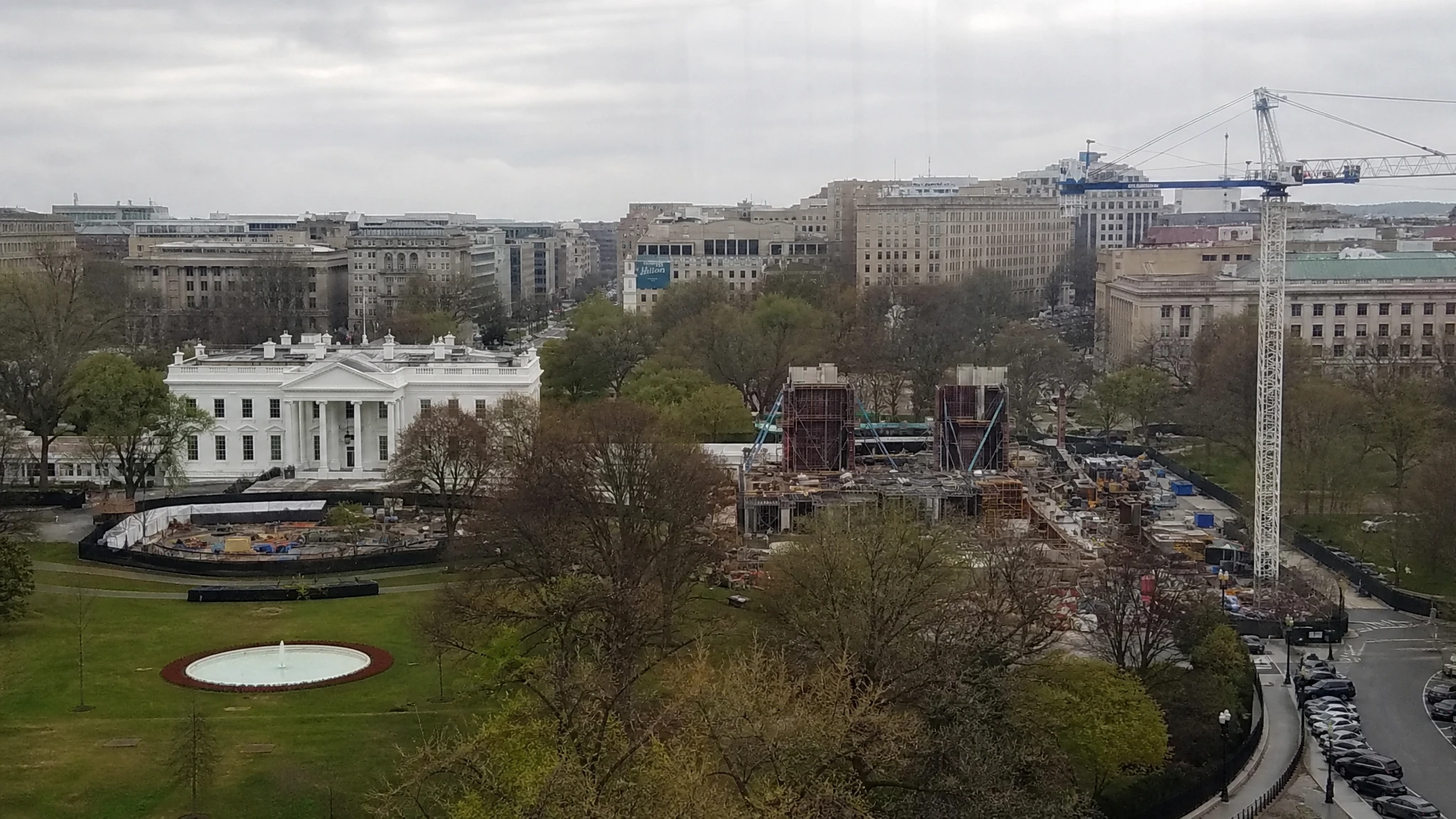
What Is the Trump White House Ballroom Lawsuit?
The Trump White House ballroom lawsuit is a federal case in which a congressionally chartered nonprofit sued the Trump administration to stop construction of a 90,000-square-foot ballroom on the site of the demolished East Wing. It is not a class action or multidistrict litigation; it has a single organizational plaintiff and no claimant class for other people to join.
The National Trust for Historic Preservation in the United States filed the complaint on December 12, 2025, in the U.S. District Court for the District of Columbia, Case No. 1:25-cv-04316, naming the National Park Service, the Department of the Interior, the General Services Administration, several officials sued in their official capacities, and President Donald Trump as defendants. The complaint asks the court to declare that the Ballroom Project violated the Administrative Procedure Act and the National Environmental Policy Act, and that federal law required congressional authorization and review by the National Capital Planning Commission and the Commission of Fine Arts before construction began, along with an injunction against further work until those reviews happen.
The case has since moved through three levels of the federal courts. A district judge granted the Trust a preliminary injunction in March 2026, the D.C. Circuit Court of Appeals upheld that injunction in August 2026, and the Supreme Court then granted the government a stay of that same injunction on August 31, 2026, allowing construction to resume while Trump's administration seeks full Supreme Court review.
“No president is legally allowed to tear down portions of the White House without any review whatsoever, not President Trump, not President Biden, and not anyone else. And no president is legally allowed to construct a ballroom on public property without giving the public the opportunity to weigh in.”
Source: National Trust for Historic Preservation in the United States v. National Park Service, et al., No. 1:25-cv-04316, Complaint for Declaratory and Injunctive Relief, para. 3 (D.D.C. Dec. 12, 2025)
Why Was the Trump White House Ballroom Lawsuit Filed?
The Trump White House ballroom lawsuit was filed because the National Trust alleges the administration skipped legally required reviews before demolishing the East Wing and starting construction of its replacement. The complaint names three core legal theories: that the Ballroom Project violated the Administrative Procedure Act by proceeding without review from the National Capital Planning Commission and the Commission of Fine Arts, that it violated the National Environmental Policy Act by skipping an environmental assessment, and that building on federal land in Washington, D.C. without congressional authorization exceeds the president's constitutional authority under the Property Clause.
The Trust says it wrote to the National Park Service, the National Capital Planning Commission, and the Commission of Fine Arts on October 21, 2025, urging a halt to demolition and the start of the required review process, and received no response. The East Wing, including a colonnade version of which dated to Thomas Jefferson's presidency, was demolished within days that same October, before any of the reviews the Trust says the law requires had taken place.
The White House has defended the project as within presidential authority, comparing it to past White House renovations such as President Truman's, and has emphasized that the roughly $400 million cost is being paid through private donations rather than taxpayer funds. That funding source does not, on its own, exempt a project on federal property from the review and approval statutes the Trust's complaint cites.
What Harms Does the Trump White House Ballroom Lawsuit Allege?
The Trump White House ballroom lawsuit alleges three distinct legal violations rather than a personal injury or financial harm, since the plaintiff is a preservation nonprofit, not an injured individual. Each is defined in plain language below, followed by what the complaint specifically alleges. No court has yet ruled on the merits of any of these claims; the rulings so far only address whether construction must pause while the case is litigated.
Administrative Procedure Act Violations
The Administrative Procedure Act (APA) is the federal law governing how agencies must act, generally requiring that major agency decisions go through defined review and comment procedures before taking effect.
The complaint alleges the Ballroom Project proceeded without the plan submissions and reviews that federal statutes require from the National Capital Planning Commission and the Commission of Fine Arts before construction on federal buildings and grounds in Washington, D.C. The Supreme Court's own August 2026 stay order did not resolve this claim on the merits; it addressed only whether the Trust has legal standing to bring it.
National Environmental Policy Act Violations
The National Environmental Policy Act (NEPA) requires federal agencies to study and disclose the environmental effects of a proposed major action before undertaking it.
The Trust alleges the Ballroom Project began without the environmental assessment NEPA requires for a project of this scale on federal land. The complaint frames this alongside the APA claim as part of the same pattern of skipping legally mandated review before construction started.
Lack of Congressional Authorization
Under the U.S. Constitution's Property Clause, Congress, not the president alone, holds authority over disposing of and making rules for property belonging to the United States.
The complaint alleges the president cannot unilaterally authorize a 90,000-square-foot addition to the White House complex without express congressional approval, a claim U.S. District Judge Richard Leon agreed with in his March 2026 opinion granting the preliminary injunction. The Trump administration disputes this theory and has argued that using privately raised funds removes the need for congressional sign-off, an argument the district court and the D.C. Circuit both rejected before the Supreme Court's stay intervened.
What Is the Current Status of the Trump White House Ballroom Lawsuit?
The current status of the Trump White House ballroom lawsuit is active litigation in the U.S. District Court for the District of Columbia, with the underlying case still pending even though the fight over a preliminary injunction has already reached the Supreme Court. As of this writing, construction may continue under the Supreme Court's stay while the government prepares its certiorari petition.
National Trust for Historic Preservation v. National Park Service, et al.
The case is proceeding in the U.S. District Court for the District of Columbia before U.S. District Judge Richard Leon, a George W. Bush appointee. Leon granted the Trust's motion for a preliminary injunction on March 31, 2026, then the D.C. Circuit Court of Appeals upheld that injunction on August 7, 2026, and the Supreme Court stayed the injunction on August 31, 2026 while it considers the government's forthcoming petition for a writ of certiorari.
| Case Number | 1:25-cv-04316 |
| Court | U.S. District Court for the District of Columbia |
| Presiding Judge | Hon. Richard J. Leon |
| Filed | December 12, 2025 |
| Plaintiff | National Trust for Historic Preservation in the United States |
| Defendants | National Park Service, Dept. of the Interior, GSA, and named officials including President Trump, sued in their official capacities |
The Supreme Court's per curiam stay order (No. 26A203) found the government likely to succeed on the merits of a narrower question than the underlying claims themselves: whether the Trust's sole basis for standing, a member's stated distaste for the ballroom's appearance, satisfies Article III's concrete-injury requirement. The order does not decide the APA, NEPA, or congressional-authorization claims themselves. Five justices formed the majority, while Chief Justice Roberts dissented along with the Court's three liberal justices.
Does the Trump White House Ballroom Lawsuit Seek Money Damages?
No. The Trump White House ballroom lawsuit does not seek money damages of any kind, since the National Trust is asking the court for declaratory and injunctive relief, a court order requiring the required reviews and approvals, not compensation for financial or physical harm.
That means there is no settlement fund, payout, or dollar amount for anyone to file a claim against, and no individual can join this case seeking compensation, since it was never structured as a claims-generating lawsuit in the first place.
The $400 million figure that appears throughout coverage of this case describes the ballroom project's own construction cost, cited by courts and reporters to explain the scale of what is at stake, not an amount either side is suing to recover.
Trump White House Ballroom Lawsuit Updates and Case Status
Here is the current status of the Trump White House Ballroom lawsuit, updated with new filings, rulings, and case-count reports as they're confirmed. No settlement date has been set as of September 2026; the Trump White House Ballroom MDL remain in active pretrial litigation. Every verified development is listed in the timeline below, in order.
Trump White House Ballroom Lawsuit Timeline
Reporting Confirms the Supreme Court Stay Passed on a 5-4 Vote
NBC News and CNBC reported that five justices formed the majority granting the government's stay application in National Park Service v. National Trust for Historic Preservation, No. 26A203, with Chief Justice Roberts and the Court's three liberal justices dissenting. The National Trust's own statement on the ruling says the 5-4 majority addressed only standing and did not decide whether the ballroom project itself is legal. Source: https://www.nbcnews.com/politics/supreme-court/supreme-court-allows-trump-move-forward-white-house-ballroom-construct-rcna594097 and https://savingplaces.org/press-center/media-resources/statement-supreme-court-national-trust-v-nps
Supreme Court Stays the Injunction, Allowing Construction to Resume
The U.S. Supreme Court granted the Trump administration's application for a stay in a per curiam order (No. 26A203), finding the government likely to succeed on the question of whether the National Trust has Article III standing to challenge the project. Chief Justice Roberts dissented. The stay lets construction continue while the government prepares a petition for a writ of certiorari.
D.C. Circuit Upholds the Injunction in a 2-1 Ruling
A three-judge panel of the U.S. Court of Appeals for the District of Columbia Circuit ruled 2-1 that Trump lacks unilateral authority to build the ballroom without congressional approval, upholding the district court's injunction while Judge Neomi Rao dissented. The panel stayed its own ruling for two weeks to let the administration seek Supreme Court review.
D.C. Circuit Temporarily Stays the Injunction Pending Appeal
The U.S. Court of Appeals for the District of Columbia Circuit stayed the district court's preliminary injunction while it considered the government's appeal, effectively allowing construction to continue in the interim, a stay that remained in place until the same court ruled on the merits in August 2026.
District Court Grants a Preliminary Injunction Halting Construction
U.S. District Judge Richard Leon granted the National Trust's motion for a preliminary injunction, ruling that no statute gives Trump authority to build the ballroom without congressional authorization and ordering aboveground construction to stop except work strictly necessary to protect the White House, the president, and his staff. The Trump administration appealed immediately.
National Trust for Historic Preservation Files the Lawsuit
The National Trust for Historic Preservation in the United States filed its complaint in the U.S. District Court for the District of Columbia, naming the National Park Service, the Department of the Interior, the General Services Administration, and President Trump as defendants and seeking to halt the Ballroom Project until required federal reviews and congressional authorization take place.
National Trust Warns Federal Agencies Before Filing Suit
The National Trust wrote to the National Park Service, the National Capital Planning Commission, and the Commission of Fine Arts urging them to halt demolition of the East Wing and begin the review process the Trust says federal law requires, a warning the complaint states went unanswered before the East Wing came down.
East Wing Demolished to Make Way for the Ballroom
Demolition crews tore down the White House's historic East Wing, including a colonnade dating in earlier form to Thomas Jefferson's presidency, within days in October 2025, clearing the site for the planned ballroom before any of the federal reviews the later lawsuit would challenge had taken place.
Who Are the Defendants in the Trump White House Ballroom Lawsuit?
The Trump White House ballroom lawsuit names a mix of federal agencies and individual officials sued in their official capacities, not personal defendants facing individual liability. President Donald Trump is named as a defendant because the complaint alleges he personally planned and directed both the East Wing's demolition and the ballroom's construction, exceeding, in the Trust's view, the authority the Constitution gives the executive branch over federal property.
The other named defendants are the agencies and officials the complaint says were responsible for the reviews it alleges never happened: the National Park Service and its Acting Director, Jessica Bowron; the Superintendent of the White House and President's Park, John Stanwich; the Department of the Interior and Secretary Douglas Burgum; and the General Services Administration and its Acting Administrator, Michael J. Rigas. None of these defendants has been found liable for anything as of this writing; the rulings issued so far address only whether construction must pause while the underlying claims are litigated.
| Defendant | Role |
|---|---|
| Donald J. Trump | President of the United States, sued in his official capacity |
| National Park Service | Federal agency managing the White House and President's Park |
| Jessica Bowron | Acting Director, National Park Service, sued in her official capacity |
| John Stanwich | Superintendent, White House and President's Park, sued in his official capacity |
| Department of the Interior | Federal agency overseeing the National Park Service |
| Douglas Burgum | Secretary of the Interior, sued in his official capacity |
| General Services Administration | Independent agency supporting federal construction projects |
| Michael J. Rigas | Acting Administrator, GSA, sued in his official capacity |
The White House has responded publicly rather than through case-specific defenses reported in coverage so far, calling the ballroom a "much needed and exquisite addition" and arguing the president has the same authority past presidents used for prior White House renovations.
How Does the Ballroom Lawsuit Compare to Other Challenges to the Project?
The National Trust's case is the primary and most-advanced legal challenge to the White House ballroom project, but coverage of the project has also referenced a separate National Park Service assessment questioning a planned triumphal arch near the Lincoln Memorial, a different proposed structure entirely with no shared docket or plaintiff.
The Trust's suit should also not be confused with routine administrative reviews of the project, such as the Commission of Fine Arts' unanimous vote approving the ballroom's design or the National Capital Planning Commission's own review, both of which are the very review processes the lawsuit says came too late, after demolition and construction had already begun, rather than a separate legal challenge in their own right.
| Matter | What It Is | Status |
|---|---|---|
| National Trust lawsuit (this page) | Federal suit alleging APA/NEPA/authorization violations | Active; Supreme Court stay in place as of Aug. 31, 2026 |
| Commission of Fine Arts review | Federal design-review panel vote on the ballroom's design | Approved the design; not a lawsuit |
| National Capital Planning Commission review | Federal land-use review the lawsuit alleges came too late | Reviewed the project after demolition had begun |
| Lincoln Memorial triumphal arch assessment | A separate proposed structure near the Lincoln Memorial | Flagged by the National Park Service; no related lawsuit filed |
Frequently Asked Questions
What is the Trump White House ballroom lawsuit about?
The Trump White House ballroom lawsuit is a federal case in which the National Trust for Historic Preservation alleges the Trump administration demolished the White House's East Wing and began building a 90,000-square-foot ballroom without the environmental review, commission review, and congressional authorization federal law requires.
Is the Trump White House ballroom lawsuit a class action?
No. The Trump White House ballroom lawsuit is a single-plaintiff federal case brought by one nonprofit organization, not a class action or multidistrict litigation, and there is no claimant class for other people or organizations to join.
Who filed the lawsuit against Trump's White House ballroom?
The National Trust for Historic Preservation in the United States, a nonprofit chartered by Congress in 1949, filed the lawsuit on December 12, 2025, naming the National Park Service, the Department of the Interior, the General Services Administration, and President Trump as defendants.
Has the Trump White House ballroom lawsuit settled?
No. The case has not settled, and because it seeks declaratory and injunctive relief rather than money damages, it was never structured to produce a settlement fund or payout for claimants in the first place.
Is construction on the White House ballroom currently stopped?
As of this writing, no. The Supreme Court granted the government a stay on August 31, 2026 that allows construction to continue while the administration seeks full review, even though both the district court and the D.C. Circuit had previously ordered work halted.
Can I join the Trump White House ballroom lawsuit?
No. This case has a single organizational plaintiff and no recruitable class of claimants, so there is no intake process, eligibility criteria, or filing procedure for an individual member of the public to join it.