
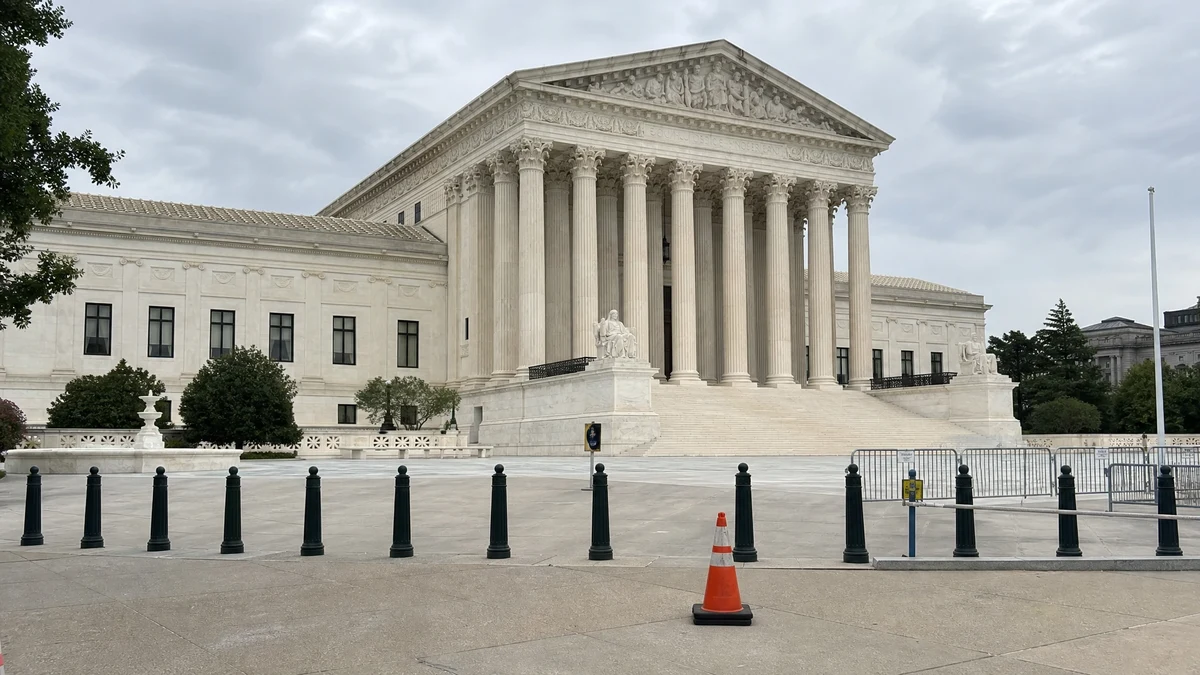
What Is the Florida Versus California Lawsuit?
The Florida versus California lawsuit is an original-jurisdiction case, Florida v. California and Washington, No. 162, Original, in which Florida asked the U.S. Supreme Court for permission to sue California and Washington over commercial driver's licenses.
Article III gives the Supreme Court original jurisdiction over cases in which a state is a party, and federal law makes that jurisdiction exclusive for disputes between states. No lower court could hear Florida's claims. The Court nonetheless treats these cases as discretionary, so a state must first file a motion for leave to file a bill of complaint.
The Court denied that motion on May 26, 2026. The complaint was therefore never filed, and no court has decided whether Florida's claims are correct.
The case is not a class action, a multidistrict litigation, or a personal injury suit. Florida sued through Attorney General James Uthmeier, and both defendants are states.
Florida also filed a second, unrelated original action against California in October 2025, which concerns a corporate tax rule. This page covers the driver's license case, and the tax case is described in the comparison section below.
“Florida claims that Washington and California laws are preempted by federal law to the extent that they prohibit licensing officials from asking applicants about immigration status. Florida also claims that both States' disregard of federal commercial licensing standards constituted an actionable public nuisance.”
Source: Supreme Court of the United States, Florida v. California and Washington, No. 162, Orig., Justice Thomas, with whom Justice Alito joins, dissenting from the denial of motion for leave to file complaint (May 26, 2026)
Why Was the Florida Versus California Lawsuit Filed?
The Florida versus California lawsuit was filed because Florida alleges that California and Washington issued commercial driver's licenses in violation of federal safety and immigration-status standards, and that the resulting drivers endanger other states.
The immediate trigger was a crash on August 12, 2025. Harjinder Singh attempted a U-turn across the median of Florida's Turnpike, his trailer swung across both lanes, and a minivan behind him could not avoid it. All three people in the minivan died, and Singh was arrested on vehicular homicide charges, according to the Supreme Court's published dissent.
Federal officials tested Singh's English proficiency after the crash. According to the same dissent, he answered most verbal questions incorrectly and identified only one of four highway signs. Singh held a Washington commercial license and a California non-domiciled commercial license, which is a short-term license for immigrants who lack lawful permanent resident status.
Florida's complaint argues the problem extends beyond one crash. It says commercial drivers routinely cross state lines, and that Florida adopted costly preventative measures after the crash to limit improperly licensed drivers. California and Washington dispute Florida's account, and the Supreme Court never reached the merits.
What Harms Does the Florida Versus California Lawsuit Allege?
The Florida versus California lawsuit alleges two distinct legal harms: a federal preemption violation and a public nuisance. Florida pleaded them as two counts, and each is defined in plain language below. The harm alleged is a public-safety and sovereignty harm to Florida as a state, not an injury to an individual claimant, and no court has ruled on either count.
Federal Preemption
Federal preemption is a constitutional doctrine under the Supremacy Clause that displaces a state law when it conflicts with a valid federal law.
Count I of Florida's bill of complaint alleges that the California Values Act (SB 54) and Washington's Keep Washington Working Act are preempted to the extent they stop licensing agencies from asking applicants about immigration status. Florida points to the Commercial Motor Vehicle Safety Act and federal rules at 49 C.F.R. 383.71 and 383.73, which require proof of citizenship, permanent residency, or lawful presence before a commercial license issues.
California's brief in opposition answers that SB 54 restricts only California law enforcement agencies and does not reach the state Department of Motor Vehicles, so the claimed conflict does not exist.
Public Nuisance
A public nuisance is an unreasonable interference with a right shared by the general public, such as public safety, which a court can order stopped.
Count II alleges that California's and Washington's failure to enforce federal safety and immigration-status standards for commercial licenses is a public nuisance, because licensed drivers travel across state lines and put other states' residents at risk. The complaint cites the August 2025 crash as its main example.
Washington's brief argues that Florida lacks standing, since a state suing another state must show injury caused directly by that state and not by a third party. California's brief adds that Florida admitted in its own filing that the facts of California's license issuance to Singh were unclear.
What Is the Current Status of the Florida Versus California Lawsuit?
The current status of the Florida versus California lawsuit is closed at the threshold stage, because the Supreme Court denied Florida's motion for leave to file a bill of complaint on May 26, 2026. No complaint was filed, no judge handled the merits, and the Supreme Court docket shows no entry after that order as of October 4, 2026. Related agency and criminal proceedings tied to the same crash continue separately.
Florida v. California and Washington
Florida filed its motion for leave on October 16, 2025, and the Court docketed it on October 20, 2025. A coalition of 17 states led by Iowa filed an amicus brief supporting Florida on December 19, 2025. California and Washington each filed a brief in opposition on January 27, 2026. The Court then distributed the motion for eight conferences between March and May 2026 before acting on it.
| Case Number | No. 162, Original (22O162) |
| Court | Supreme Court of the United States (original jurisdiction) |
| Plaintiff | State of Florida |
| Defendants | State of California and State of Washington |
| Motion Filed | October 16, 2025 (docketed October 20, 2025) |
| Decided | May 26, 2026 |
| Disposition | Motion for leave to file a bill of complaint denied, no reasons given |
| Dissent | Justice Thomas, joined by Justice Alito |
The order is one sentence long and gives no reasons. Justice Thomas, joined by Justice Alito, wrote a five-page dissent arguing that the Court has no discretion to refuse suits between states. He added that Florida's claim satisfied the Court's two-part test, which looks at the seriousness of the claim and the availability of another forum.
A denial of leave is not a ruling that Florida's claims were wrong. It means the suit never passed the permission stage. California and Washington argued standing, the absence of a sovereign-level dispute, and the availability of federal agency enforcement, and the Court did not say which argument, if any, it accepted.
Does the Florida Versus California Lawsuit Seek Money Damages?
No. The Florida versus California lawsuit sought declaratory and injunctive relief rather than money damages, apart from Florida's costs and attorneys' fees.
Florida's prayer for relief asked for declarations that the states' sanctuary laws are preempted and that their licensing practices are a public nuisance. It also asked for injunctions stopping California and Washington from issuing commercial licenses to applicants who are not citizens or lawful permanent residents, and from issuing non-domiciled licenses that fail 49 C.F.R. 383.71(f). Because the Court denied leave to file, none of that relief was granted, and no settlement, fund, or claim process exists.
Private individuals cannot join this case or claim compensation from it, since the plaintiff is a state and no class exists. Any individual claims arising from the Turnpike crash would be separate proceedings, and none are part of this case.
Florida Versus California Lawsuit Updates and Case Status
The Florida versus California lawsuit updates and case status below track the Supreme Court docket, the related federal regulatory actions, and the criminal case tied to the same crash. The original action itself is closed, so the later entries describe adjacent proceedings. Every verified development appears in order in the timeline below.
Florida Versus California Lawsuit Timeline of Events
Turnpike Crash Kills Three Near Fort Pierce
A tractor-trailer driven by Harjinder Singh attempted a U-turn across the median of Florida's Turnpike, and a minivan struck the trailer, killing all three of its occupants. The Supreme Court's later dissent in Florida v. California and Washington describes this crash as the event that prompted Florida's suit.
Singh Arrested on Vehicular Homicide Charges
News reporting dated August 18, 2025, which California's brief in Florida v. California and Washington cites, confirms that Florida authorities arrested Singh after the Turnpike crash. The charges were three counts of vehicular homicide, and Singh later pleaded not guilty.
FMCSA Issues Preliminary Finding Against California
The Federal Motor Carrier Safety Administration told California on September 26, 2025 that its non-domiciled commercial license program was out of compliance in some respects, according to California's brief in the Florida case. FMCSA had reviewed 145 driver records and found three missing proofs of legal-presence verification.
FMCSA Interim Rule Narrows Non-Domiciled Licenses
FMCSA published an interim final rule on September 29, 2025 limiting non-domiciled commercial licenses to holders of H-2A, H-2B, or E-2 visas. The rule came about seven weeks after the Turnpike crash and shortly before Florida's filing, and the D.C. Circuit stayed it on November 13, 2025 in a separate private challenge.
Washington Acknowledges Licensing Error
Washington acknowledged that it had erred in issuing Singh and 685 other non-citizens full-term commercial licenses, according to an Overdrive report dated October 1, 2025 that the Supreme Court's dissent cites. The admission concerns Washington's own licensing, and it is not a finding made in Florida's case.
FMCSA Finalizes English-Proficiency Finding for California
FMCSA issued a final determination of nonconformity against California on October 15, 2025. California's brief says the finding faulted California's continuing duty to check English proficiency at roadside inspections, and not its testing before issuing licenses.
Florida Asks the Supreme Court to Hear Its Suit
Florida filed a motion for leave to file a bill of complaint against California and Washington in the Supreme Court on October 16, 2025, and the Court docketed the case as No. 162, Original, four days later. The proposed complaint pleaded federal preemption and public nuisance.
Florida Files a Second Original Action Over California Tax Rules
Florida filed a separate motion for leave in Florida v. California and Franchise Tax Board of California, No. 163, Original, on October 28, 2025. That case challenges a California corporate tax regulation, and the Court docketed it on November 3, 2025.
Court Extends Response Deadline to January 27
The Supreme Court granted California and Washington more time on December 3, 2025 in No. 162, Original, moving their response deadline from December 29, 2025 to January 27, 2026. The extension followed a request submitted on November 18, 2025.
Seventeen States Back Florida's Bid for Review
Iowa and 16 other states filed an amicus brief on December 19, 2025 in Florida v. California and Washington supporting Florida's motion. The brief argues that the Constitution and federal law require the Supreme Court to hear disputes between states.
FMCSA Issues Final Noncompliance Determination for California
FMCSA issued a final determination of substantial noncompliance against California's commercial license program on January 7, 2026. California's brief says the finding rested mainly on delayed cancellation of licenses with inaccurate expiration dates, and not on a refusal to verify legal presence.
California and Washington Oppose Florida's Motion
California and Washington each filed a brief in opposition on January 27, 2026 in No. 162, Original. California argued its DMV verifies legal presence and tests English proficiency, and Washington argued that Florida lacks standing.
FMCSA Publishes Final Non-Domiciled License Rule
FMCSA published a final rule on February 13, 2026 adopting the interim rule's eligibility limits to H-2A, H-2B, and E-2 visa holders, with no substantive changes, according to a law-firm alert. The rule took effect 30 days after publication.
Court Begins Repeated Conference Listings
The Supreme Court first distributed Florida's motion in No. 162, Original for conference on March 20, 2026. The docket shows eight distributions in total, ending with the conference of May 21, 2026.
Supreme Court Denies Florida's Motion; Thomas and Alito Dissent
The Supreme Court denied Florida's motion for leave to file a bill of complaint in Florida v. California and Washington on May 26, 2026, without explanation. Justice Thomas, joined by Justice Alito, dissented and wrote that the Court cannot refuse to hear suits between states.
Singh Appears in St. Lucie County Court
Harjinder Singh appeared in person before a St. Lucie County judge on May 27, 2026, one day after the Supreme Court denied Florida's motion, according to a KATV report. The judge denied a motion to quash a notice of appearance, and Singh has pleaded not guilty.
Court Also Denies Florida's California Tax Case
The Supreme Court denied Florida's motion for leave in Florida v. California and Franchise Tax Board of California, No. 163, Original, on June 1, 2026. Justice Thomas, joined by Justice Alito, dissented for the reasons he gave in Nebraska v. Colorado (2016).
Report Details FMCSA Funding Withholding From California
A Trucking Dive report dated July 10, 2026 said FMCSA found roughly 20,000 California non-domiciled licenses improperly issued and moved to withhold about $160 million in federal funding, which California challenged in California Department of Motor Vehicles v. FMCSA in the D.C. Circuit. The report said oral argument was set for September 11, 2026, and this page has not located a ruling.
What Did Regulators Find About California and Washington in the Florida Versus California Lawsuit?
Federal regulators and the defendant states made several findings that bear on Florida's allegations, but none of them is a court finding in this case. FMCSA reviews each state's commercial license program and can withhold funding or rescind a state's licensing authority if it finds substantial noncompliance.
Most California findings come from California's own description of FMCSA letters in its brief, so the primary FMCSA documents should be consulted before relying on any characterization. Washington's admission of error comes from a news report that the Supreme Court dissent cites.
| Date | Source | Finding or position |
|---|---|---|
| Sept. 26, 2025 | FMCSA preliminary determination (California) | Reviewed 145 driver records and found three missing proofs of legal-presence verification, plus other errors such as wrong expiration dates |
| Oct. 1, 2025 | Washington (Overdrive report cited in the dissent) | Acknowledged erring in issuing Singh and 685 other non-citizens full-term commercial licenses |
| Oct. 15, 2025 | FMCSA final determination (California) | Nonconformity on English proficiency, tied to California's roadside inspection duty after licensing |
| Jan. 7, 2026 | FMCSA final determination (California) | Substantial noncompliance, based mainly on delayed cancellation of licenses with inaccurate expiration dates |
| July 10, 2026 | Trucking Dive report | About 20,000 licenses found improperly issued, with about $160 million in federal funding slated to be withheld from California |
California says its DMV verifies legal presence through a federal database and tests English proficiency. Its brief says the DMV issued Singh a non-domiciled license on July 23, 2024, after verifying his work authorization and after he passed a knowledge test on a second attempt. Washington says Singh no longer held a valid Washington license when the crash occurred and called Florida's suit a political stunt. Neither state's account was tested in court.
How Does the Florida Versus California Lawsuit Compare to Florida's Tax Case Against California?
The Florida versus California lawsuit over driver's licenses is distinct from Florida v. California and Franchise Tax Board of California, No. 163, Original. That second case challenges 18 Cal. Code Regs. 25137(c)(1)(A), a California rule that excludes certain substantial, occasional sales from the sales factor used to apportion corporate income. Florida argued the rule violates the Commerce Clause, the Import-Export Clause, and the Due Process Clause.
Both cases were denied at the leave stage, and Justices Thomas and Alito dissented in both. They are separate dockets with different briefs, different California lawyers, and different subject matter, so facts from one do not apply to the other.
| Case | Forum | Subject | Status |
|---|---|---|---|
| Florida v. California and Washington, No. 162, Orig. | U.S. Supreme Court | Commercial driver's license issuance | Leave denied (this page's case) |
| Florida v. California and Franchise Tax Board of California, No. 163, Orig. | U.S. Supreme Court | California corporate tax apportionment rule | Leave denied June 1, 2026 |
| State criminal case against Harjinder Singh | St. Lucie County, Florida | Vehicular homicide charges from the Turnpike crash | Singh pleaded not guilty, outcome not located |
| Lujan v. FMCSA, No. 25-1215 | D.C. Circuit | Private challenge to FMCSA's interim non-domiciled license rule | Interim rule stayed Nov. 13, 2025, later status not verified |
| California DMV v. FMCSA | D.C. Circuit | Federal funding withheld from California | Argument set for Sept. 11, 2026, ruling not located |
Justices Thomas and Alito have dissented from earlier denials of leave in suits between states, including Texas v. California (2021) and Alabama v. California (2025), as the Florida dissent itself notes.
Frequently Asked Questions
What is the Florida versus California lawsuit about?
The Florida versus California lawsuit is a Supreme Court original action in which Florida asked to sue California and Washington over commercial driver's licenses issued to non-citizens. Florida alleged federal preemption and public nuisance, and the Court denied its request without ruling on the merits.
Is the Florida versus California lawsuit a class action?
No. The Florida versus California lawsuit is not a class action or a multidistrict litigation, because the plaintiff is the State of Florida and the defendants are the states of California and Washington. No private individuals are class members.
Did the Supreme Court rule on the Florida versus California lawsuit?
The Supreme Court did not rule on the merits of the Florida versus California lawsuit. It denied Florida's motion for leave to file a bill of complaint without explanation, and Justices Thomas and Alito dissented.
Did the Florida versus California lawsuit settle or award damages?
No. The Florida versus California lawsuit did not settle, and no damages were awarded. Florida sought declarations and injunctions plus its costs and fees, and the Court denied leave to file.
Is Florida's California tax lawsuit the same case?
No. Florida's California tax lawsuit is a separate original action, No. 163, Original, against California and its Franchise Tax Board over a corporate tax rule. The Court denied leave there on June 1, 2026, and it has no connection to commercial driver's licenses.
What happened to the truck driver in the Florida versus California lawsuit?
Harjinder Singh faces a separate Florida criminal case in St. Lucie County on three vehicular homicide counts and has pleaded not guilty. That case is not part of the Florida versus California lawsuit, and this page did not locate a trial outcome.
Which states supported Florida in the Florida versus California lawsuit?
Iowa and 16 other states filed an amicus brief supporting Florida in the Florida versus California lawsuit. Their brief argued that the Supreme Court should hear disputes between states, and the Court still denied Florida's motion.