
What Is the Phillip Reinink Excessive Force Lawsuit?
The Phillip Reinink excessive force lawsuit is a federal civil rights case, Hart v. City of Grand Rapids. Sean Hart and Tiffany Guzman sued after Grand Rapids police used force on Hart during a May 30, 2020 protest downtown.
The case is docketed as No. 1:20-cv-00899 in the U.S. District Court for the Western District of Michigan. Judge Jane M. Beckering handled it at the time of the 2023 summary judgment ruling. Hart and Guzman filed it under 42 U.S.C. § 1983 on September 16, 2020.
The case is a dispute between two plaintiffs and several defendants, not a class action. No group of other claimants exists to join it.
“Sean Hart and Tiffany Guzman appeal the district court’s dismissal of their excessive force claims under 42 U.S.C. § 1983 against the City of Grand Rapids, Sergeant Brad Bush, and Officers Benjamin Johnson and Phillip Reinink. Hart and Guzman claim that the officers employed excessive force during a 2020 Black Lives Matter demonstration in Grand Rapids and that the City ratified this unlawful conduct.”
Source: U.S. Court of Appeals for the Sixth Circuit, Hart v. City of Grand Rapids, No. 23-1382, Opinion (May 15, 2025)
Why Was the Phillip Reinink Excessive Force Lawsuit Filed?
The Phillip Reinink excessive force lawsuit was filed because Hart says Reinink fired a long-range tear gas canister at him while unarmed. Reinink says he believed his launcher held a different, close-range munition.
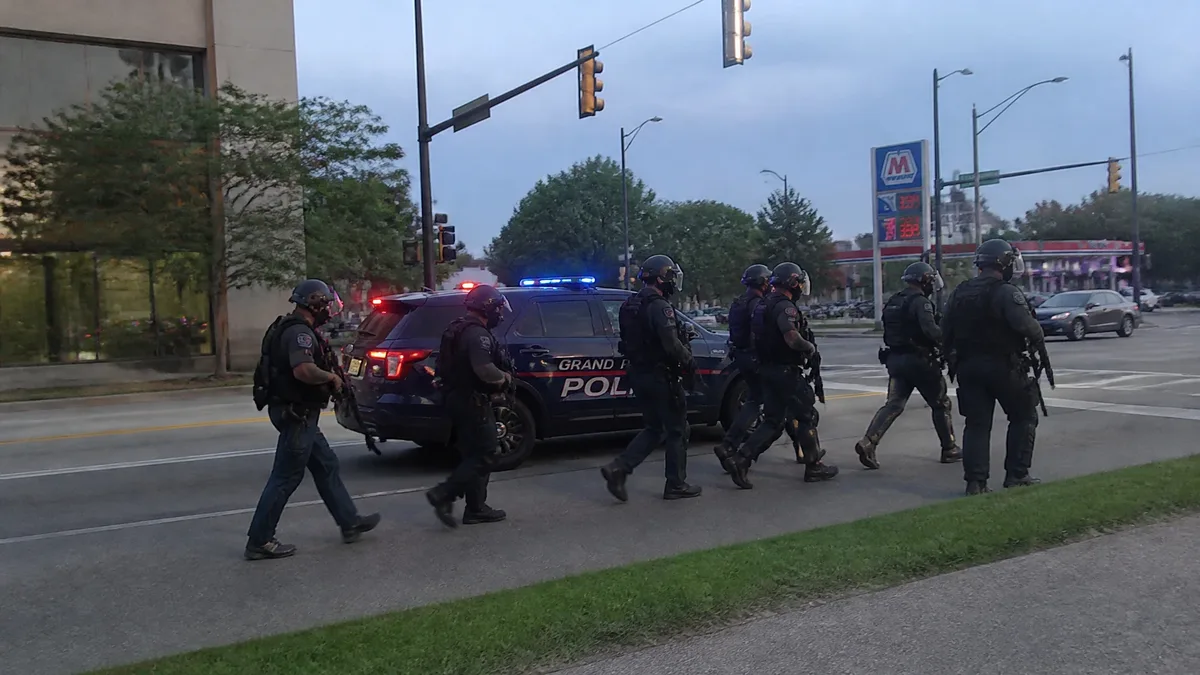
Hart and Guzman drove downtown after fishing and hearing sirens, where a demonstration had turned violent. Hart approached the police line, and Sergeant Brad Bush pepper sprayed him. Reinink then fired a Spede-Heat canister, which hit Hart's left shoulder. Spede-Heat is designed to be launched into a target area, not directly at a person.
The Sixth Circuit also records that Hart returned after being told to leave and walked toward officers with a hand in his pocket. The court found he was unarmed and holding a cigarette when Reinink fired.
The complaint, filed September 16, 2020, has three counts: excessive force against three officers, municipal liability against the City, and state-law claims. WOOD-TV reported that the suit sought $75,000.
What Harms Does the Phillip Reinink Excessive Force Lawsuit Allege?
The Phillip Reinink excessive force lawsuit includes four distinct categories of harm: excessive force, deadly force, physical injury, and municipal liability. Each is a legal theory or injury that Hart and Guzman raised or that the courts analyzed. No court has found any of these harms proven against Reinink.
Excessive Force
Excessive force is a civil rights claim that police used more force than a situation reasonably required.
Hart and Guzman pled excessive force under the Fourth and Fourteenth Amendments against Reinink, Bush and Johnson. Their claims covered Bush's pepper spray, Johnson pointing a launcher at Guzman's side of the car, and Reinink's canister.
The courts granted qualified immunity to Bush and Johnson. Only the claim over Reinink's canister survives.
Deadly Force
Deadly force is force likely to cause death or serious bodily harm. Courts ask whether the person posed an imminent threat of serious harm.
The Sixth Circuit analyzed Reinink's canister as deadly force, because the nature of the force matters more than the weapon. Reinink testified that he was trained that some uses of Spede-Heat could cause serious injury or death.
The court also held that Reinink's intent is irrelevant under the governing Graham v. Connor standard. That means his belief that he had loaded a different munition does not decide the Fourth Amendment question.
Physical Injury
A physical injury in a civil rights case is bodily harm, such as bruising, that a plaintiff blames on an officer's force.
Hart received emergency room treatment for left shoulder pain and eye irritation from the pepper spray. Photos corroborate his testimony that the canister left an abrasion and bruising on his left shoulder.
Guzman had no physical injuries. Fox 17 reported that the complaint alleged both plaintiffs suffered physical injuries and emotional distress.
Municipal Liability
Municipal liability is a claim that a city caused a constitutional violation through its own policy, custom or approval. Employing the officer is not enough.
Count two of the complaint accuses the City of Grand Rapids of failing to train its officers and ratifying unlawful force. Hart and Guzman relied on a spreadsheet of nearly 90 excessive force complaints against Grand Rapids officers from 2015 to 2020.
The Sixth Circuit affirmed summary judgment for the City. It found the spreadsheet listed only a generic allegation and a finding for each complaint, so it showed no pattern. It treated the failure-to-train theory as abandoned.
What Is the Current Status of the Phillip Reinink Excessive Force Lawsuit?
The current status of the Phillip Reinink excessive force lawsuit is that Hart's excessive force claim against Reinink has returned to the district court. The Supreme Court declined to review the case on May 26, 2026.
A denied petition is not a ruling on the merits. No court has decided whether Reinink used excessive force, and no trial date appeared in the public sources reviewed as of October 2026.
Hart v. City of Grand Rapids (W.D. Mich. and Sixth Circuit)
The district court granted summary judgment to all defendants on March 31, 2023. The Sixth Circuit reversed as to Reinink on May 15, 2025 and sent that claim back for further proceedings.
| Court | U.S. District Court, Western District of Michigan (appeal to the Sixth Circuit) |
| Case Numbers | No. 1:20-cv-00899 (district court); No. 23-1382 (Sixth Circuit) |
| Filed | September 16, 2020 |
| Plaintiffs | Sean Hart and Tiffany Guzman |
| Defendants | City of Grand Rapids; Sergeant Brad Bush; Officers Benjamin Johnson and Phillip Reinink |
| Judges | District Judge Jane M. Beckering; Sixth Circuit panel of Judges Gilman, Stranch and Larsen |
| Outcome on Appeal | Immunity affirmed for Bush and Johnson; summary judgment affirmed for the City; reversed as to Reinink and remanded |
Judge Jane B. Stranch wrote the opinion, joined by Judge Gilman. Judge Larsen concurred in part and dissented in part, arguing that Reinink should keep qualified immunity.
Reinink v. Hart (U.S. Supreme Court)
Reinink petitioned the Supreme Court to overturn the Sixth Circuit's immunity ruling. The petition asked whether an officer's intended force decides if a shot counts as deadly force. It also asked whether a reasonable mistake that produces more force than intended earns qualified immunity.
| Court | Supreme Court of the United States |
| Docket | No. 25-179 |
| Petition Filed | August 11, 2025 |
| Petitioner | Officer Phillip Reinink |
| Respondents | Sean Hart, et al. |
| Counsel | Michael T. Berger for Reinink; Christopher P. Desmond for Hart and Guzman |
| Outcome | Petition denied May 26, 2026; Justices Thomas and Alito would have granted it and summarily reversed |
Has the Phillip Reinink Excessive Force Lawsuit Settled?
No. The Phillip Reinink excessive force lawsuit has not settled, and no court has awarded Hart or Guzman any damages as of October 20, 2026.
WOOD-TV reported in 2020 that the suit sought $75,000. That figure is a reported amount sought, not an estimate of the case's value. Only a judgment or agreement can set an actual amount.
The Sixth Circuit's ruling means a jury would now weigh the evidence on Reinink's liability. The court wrote that weighing evidence and deciding liability are tasks for a jury. Denial of immunity does not mean Hart wins.
Phillip Reinink Excessive Force Lawsuit Updates
Here are the latest Phillip Reinink Excessive Force lawsuit updates, covering new court filings, rulings, and case-count reports as they're confirmed. Litigation in the Hart v. City of Grand Rapids civil rights case remains active as of October 2026, with no bellwether trial or settlement completed. See the full timeline below for every confirmed development since the litigation began.
Phillip Reinink Excessive Force Lawsuit Timeline of Events
Hart Is Hit by a Canister During the Grand Rapids Protest
Around 11:40 p.m. on May 30, 2020, Grand Rapids Police Officer Phillip Reinink fired a Spede-Heat canister that struck Sean Hart's left shoulder during a downtown demonstration. Sergeant Brad Bush had pepper sprayed Hart moments earlier.
Reinink Will Not Face Criminal Charges
Local news reported in late June 2020 that Officer Phillip Reinink would not be criminally charged over the canister shot at Sean Hart. The Kent County Prosecutor's Office cited the broad immunity officers have when dispersing riots.
Grand Rapids Police Suspend Reinink for Two Days
Grand Rapids Police Chief Eric Payne announced that an internal investigation found Officer Phillip Reinink used unreasonable force against Sean Hart. Reinink received a two-day unpaid suspension, and the chief said the department would work on its canister procedures.
Hart and Guzman File the Federal Lawsuit
Sean Hart and Tiffany Guzman filed Hart v. City of Grand Rapids in the Western District of Michigan as No. 1:20-cv-00899. The complaint named the City, Sergeant Brad Bush, Officer Benjamin Johnson and Officer Phillip Reinink.
Judge Beckering Grants Summary Judgment to All Defendants
The district court dismissed the federal claims in Hart v. City of Grand Rapids with prejudice on qualified immunity and municipal liability grounds. It declined to hear the state-law claims and dismissed them without prejudice.
Sixth Circuit Hears Oral Argument
The Sixth Circuit heard argument in Hart v. City of Grand Rapids, No. 23-1382, on June 13, 2024. Christopher P. Desmond argued for Hart and Guzman, and separate counsel argued for the City and for Reinink.
Sixth Circuit Denies Reinink Qualified Immunity
The Sixth Circuit treated Officer Phillip Reinink's close-range Spede-Heat shot at Sean Hart as deadly force and denied qualified immunity. It affirmed summary judgment for Bush, Johnson and the City. It remanded Hart's claim against Reinink.
Reinink Petitions the Supreme Court
Reinink filed a petition for certiorari in Reinink v. Hart, No. 25-179, asking the Supreme Court to reverse the Sixth Circuit's immunity ruling. The questions concerned how intent and reasonable mistakes affect deadly force and qualified immunity.
Hart Waives a Response
Respondents Sean Hart and Tiffany Guzman filed a waiver of their right to respond to Reinink's petition in No. 25-179. The waiver is routine and does not signal agreement with the petition.
The Supreme Court Requests a Response
The Supreme Court requested a response from Hart and Guzman in Reinink v. Hart, No. 25-179, due November 3, 2025. The deadline was later extended twice, ending on December 17, 2025.
Hart and Guzman File Their Opposition Brief
Sean Hart and Tiffany Guzman filed a brief opposing Reinink's petition in No. 25-179. Reinink's reply followed on January 2, 2026.
The Petition Is Rescheduled Repeatedly
The Supreme Court first rescheduled Reinink v. Hart, No. 25-179, on January 21, 2026, and the petition was redistributed for conference many times through May 2026. The docket shows no vote count for any of those conferences.
The Supreme Court Denies Review
The Supreme Court denied Phillip Reinink's petition in Reinink v. Hart, No. 25-179, leaving the Sixth Circuit's ruling in place. Justices Clarence Thomas and Samuel Alito would have granted the petition and summarily reversed.
What Did Grand Rapids Police Know About Spede-Heat in the Phillip Reinink Excessive Force Lawsuit?
Grand Rapids police knew Spede-Heat was a long-range munition not meant for close firing at a person, according to testimony the Sixth Circuit quoted. No court has yet found Reinink or the department liable.
Lieutenant Matthew Ungrey, the Special Response Team commander, testified that the canisters must be fired into the air at 45 to 60 degrees. He said firing one directly at a person would absolutely be lethal force outside a life-or-death situation. Chief Eric Payne acknowledged that firing Spede-Heat at that distance is potential deadly force.
Sergeant Bush testified that he had never heard of an officer mistaking a Spede-Heat canister for Muzzle Blast. The department's own investigation sustained an excessive force charge against Reinink. It also found he loaded the munition without a witness and turned off his body camera without reactivating it. Reinink said his camera battery died, but investigators concluded he turned it off for a privileged conversation.
Chief Payne imposed two days of unpaid leave and said the department would work with larger agencies, because the two canisters look so similar.
| Defendant | Role | Force at Issue | Sixth Circuit Result |
|---|---|---|---|
| Phillip Reinink | Grand Rapids police officer | Spede-Heat canister fired at close range | Qualified immunity denied; claim remanded |
| Brad Bush | Grand Rapids police sergeant | Pepper spray from eight to ten feet | Qualified immunity affirmed |
| Benjamin Johnson | Grand Rapids police officer | Launcher pointed at the passenger side of the car | Qualified immunity affirmed |
| City of Grand Rapids | Municipal employer | Alleged ratification of unlawful force | Summary judgment affirmed |
A sustained internal finding is a department conclusion, not a court judgment. A jury has not weighed the evidence on whether Reinink's use of force was unconstitutional.
Frequently Asked Questions
What is the Phillip Reinink excessive force lawsuit about?
The Phillip Reinink excessive force lawsuit is about a Grand Rapids officer firing a Spede-Heat canister at Sean Hart on May 30, 2020. Hart and Guzman sued under federal civil rights law. Only the claim against Reinink remains.
Is the Phillip Reinink excessive force lawsuit a class action?
No. The Phillip Reinink excessive force lawsuit is not a class action. Two plaintiffs, Sean Hart and Tiffany Guzman, brought it, so no one else can join it or file a claim.
Has the Phillip Reinink excessive force lawsuit settled?
No. The Phillip Reinink excessive force lawsuit has not settled as of October 20, 2026. No court has awarded damages, and WOOD-TV reported in 2020 that the suit sought $75,000.
Did the Supreme Court rule that Phillip Reinink used excessive force?
No. The Supreme Court did not rule that Phillip Reinink used excessive force. It denied his petition on May 26, 2026, which leaves the Sixth Circuit's denial of qualified immunity in place without deciding the merits.
What is qualified immunity in the Phillip Reinink excessive force lawsuit?
Qualified immunity in the Phillip Reinink excessive force lawsuit is a defense that shields officials from damages unless they violated clearly established rights. The Sixth Circuit granted it to Bush and Johnson but denied it to Reinink.
What happens next in the Phillip Reinink excessive force lawsuit?
What happens next in the Phillip Reinink excessive force lawsuit is further proceedings in the district court on Hart's claim against Reinink. No trial date appeared in the public sources reviewed as of October 2026.